

Anti-Jamming Antenna Solution
Anti-Jamming Antenna Solution: Secure GNSS Navigation in Complex Electromagnetic Environments
The Jamming Threat Landscape
Interference comes in many forms. In civilian settings, low-power personal privacy jammers are the most common threat, targeting the widely used GPS L1 and BeiDou B1 frequencies; they cause nuisance but their attack pattern is relatively simple. In complex and contested environments, high-power devices may attack several GNSS frequency bands at once, or generate barrage jamming that floods the band with wideband noise to paralyze PNT services entirely. More advanced threats add swept-frequency, pulse, white-noise, FM/AM/PM and harmonic signals, while spoofing attacks emit counterfeit GNSS signals to feed false positions.
A modern anti-jamming solution must therefore be frequency-aware and waveform-aware: it must detect the presence and power of interference, classify the interference type, and suppress it across the full spatial domain — not just at one frequency or one direction. SpaceTime's CRPA products are designed against exactly this spectrum of threats.
How CRPA Anti-Jamming Works
A CRPA system defeats jamming by spatial nulling. Instead of a single antenna element, the CRPA uses a compact array of antenna elements. Advanced array processing continuously estimates the direction of arrival of interfering signals and steers deep nulls toward each jammer while keeping the antenna pattern pointed at the GNSS satellites. The more elements in the array, the more independent nulls can be created — a 4-element design creates up to three simultaneous nulls.
In the StarWin implementation, each element feeds a multi-channel down converter, filter, ADC, FPGA, DAC and up-converter chain. The FPGA runs intelligent signal processing algorithms that perform digital beamforming, null-steering and waveform-domain suppression in real time, delivering stable navigation output even under simultaneous multi-direction jamming. The products also embed an interference power detection function that measures and calibrates incoming interference power — providing precise data for joint testing, equipment evaluation and field debugging.
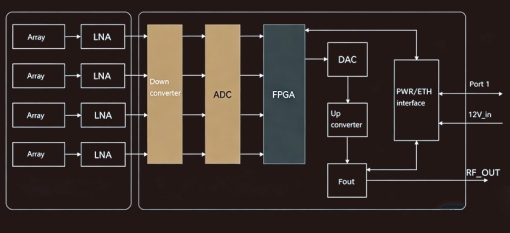
CRPA hardware architecture — multi-channel array, down converter, ADC, FPGA, DAC and up converter in one integrated chain
Product Family
SpaceTime's CRPA family covers the full spectrum of platform requirements, from ultra-compact UAV antennas to high-protection anti-spoofing arrays and multi-system all-in-one receivers.
TZ023 Series — Multi-System All-in-One Anti-Jamming Receivers
The TZ023 series (MIN / STD / ULT) is a miniaturized multi-system anti-jamming all-in-one device developed for industrial users such as UAVs. It integrates an antenna array, anti-jamming processing and a satellite navigation receiver in a single unit, supporting GPS + GLONASS reception on dual frequencies (GPS L1 1575.42 MHz, GLO-G1 1602 MHz) with 8 anti-interference channels. Anti-jamming performance reaches J/S ≥ 110 dB for single interference, ≥ 100 dB for triple and ≥ 90 dB for seven simultaneous interference sources. Positioning accuracy is ≤ 1.5 m without interference and ≤ 10 m under interference, timing accuracy ≤ 100 ns, and the device supports serial or RF output, NMEA/U-blox protocols, software upgrade, self-check, interference detection and 10 W continuous anti-burn protection.
Smart-city low-altitude traffic — UAVs and autonomous vehicles protected by compact CRPA antennas
Applications
The CRPA family adapts to almost any platform and any electromagnetic environment:
• UAVs, UGVs and USVs: navigation security for unmanned aerial, ground and surface vehicles, including low-altitude economy operations, surveying and logistics drones.
• Vehicle-mounted and fleet applications: fleet defense navigation security, high-end logistics navigation security, and connected vehicle platforms.
• Timing security: stable PNT timing for power grids, communications networks, finance and data centers — where a lost time lock can disrupt the entire system.
• Fixed sites and base stations: public mobile communication base stations, measurement and control stations, and fixed monitoring posts.
• Defense and security: naval platforms, ground vehicles and airborne systems where jamming and spoofing are a realistic, continuous threat.
Testing and Verification
Every SpaceTime CRPA product is verified by engineering testing before delivery. In the anti-barrage jamming test (January 2026, open rooftop), the antenna under test faced GNSS wideband barrage jamming at 20 Msps symbol rate with a jamming power of −40 dBm measured at the receiving antenna, covering no-jamming, single, dual and triple interference scenarios. The TZ023MIN and TZ023STD models all passed the respective single, dual and triple interference suppression thresholds documented in their test reports. The products also meet GJB150A rain test requirements and operate across −40 °C to +55 °C with 96% humidity, confirming suitability for field, maritime and airborne environments.
Solution Value
StarWin's anti-jamming antenna solution gives integrators and operators one supplier for the full protection spectrum: ultra-compact antennas for drones, higher-protection arrays for vehicles and fixed sites, anti-spoofing arrays for defense, and multi-system all-in-one receivers for industrial GNSS products. All products share the same core — self-developed array antenna technology and intelligent signal processing — which means consistent behavior, documented test evidence and easy integration across fleets. With compact size, low power, one-cable integration, interference power detection and software upgradeability, SpaceTime CRPA products protect position, velocity and time — the data every autonomous system, critical network and defense platform depends on.
Interested in this solution? Let us help you get connected.